

By admin September 14, 2026
The fireworks retail license requirements by state are not satisfied merely because a company has formed an LLC, obtained a tax registration, or secured a general business license.
A fireworks retailer may need approvals at several levels: a state fireworks license or fire-marshal authorization, county or municipal approval for the specific sales location, insurance documentation, and an inspection or operating approval under the fire code actually adopted in that jurisdiction.
Payment underwriters may then request copies of those records when deciding whether a merchant account accurately reflects a lawful fireworks retail operation.
The central compliance issue is the document chain: business structure → state authorization → local location approval → insurance → inspection → operating permit → processor underwriting file → renewal monitoring.
There is also an important NFPA distinction as of September 14, 2026. The current 2026 edition of NFPA 1124 is titled Code for the Manufacture, Transportation, and Storage of Fireworks and Pyrotechnic Articles. NFPA’s current technical-committee materials exclude retail sales and related storage of consumer fireworks from the scope.
Yet some state and local laws continue to incorporate older NFPA 1124 editions that contained consumer-retail provisions. That means a retailer cannot simply look up the newest NFPA edition and assume it controls the stand. The adopted state or local law controls.
This article provides general compliance and payment-industry information, not individualized legal advice. Actual licensing authorities, deadlines, fees, insurance requirements, inspections, permitted products, and payment-underwriting requirements must be verified for each location before sales begin.
Fireworks Retail License Requirements by State: The Three Regulatory Layers
There is no single federal retail-fireworks license that authorizes an ordinary consumer-fireworks stand to operate everywhere in the United States. Fireworks retail license requirements by state can be structured very differently, and cities or counties may impose another approval layer even after state requirements have been satisfied.
A permanent store, temporary roadside stand, tent, seasonal pop-up, and multi-location retail operation may therefore encounter different combinations of approvals.
| Layer | Authority | Typical Approval | What to Verify |
| State | State fire marshal, commerce department, agriculture department, or another designated agency | Retail license, registration, seasonal permit, or product-category authorization | Agency, products covered, location requirements, renewal period |
| County/municipality | Fire prevention, planning, zoning, building, licensing, or local government | Fire permit, temporary-use permit, zoning approval, local business license | Whether approval is site-specific and whether local rules are stricter |
| Fire-code layer | State/local code authority | Compliance with adopted fire code | Actual code and edition adopted, amendments, inspection requirements |
| Supporting documentation | Insurer and inspecting authority | COI, inspection record, property/site documents | Required form, named entity, site address, effective dates |
| Payment underwriting | Processor, acquirer, sponsor bank | Merchant approval or continuing account eligibility | Current permits, location list, insurance, product mix, supplier evidence |
The state layer
A state may place consumer-fireworks retail licensing with the state fire marshal or another agency. It may distinguish seasonal sales from permanent retailing, impose location-specific registration, restrict which products can be sold, or leave a significant part of seasonal retail permitting to local governments.
Kansas illustrates why merchants must verify the actual structure rather than assuming every state issues the same permit. The Kansas State Fire Marshal says seasonal retail-stand permitting is left to local authorities, while permanent fireworks retailers must register annually with the state.
Kansas also states that its seasonal-retail framework uses the 2006 edition of NFPA 1124 for technical aspects of stands.
The county and municipal layer
A state authorization does not necessarily give the operator permission to use a particular parcel as a temporary fireworks retail location.
Local government may separately control zoning, temporary structures, temporary-use approvals, fire inspections, signs, occupancy issues, business licensing, or other site-specific matters. The responsible offices differ widely.
That is why fireworks retail license requirements by state should really be evaluated location by location. Two stands owned by the same LLC and operating in the same state can face different municipal requirements.
The fire-code layer
The fire-code requirement is a separate question from the identity of the licensing agency.
Depending on the jurisdiction, applicable requirements may arise through a state fire code, local amendments, an International Fire Code framework, an incorporated NFPA edition, or another statutory or regulatory scheme. The adopted law—not the mere existence of a model standard—determines the merchant’s legal duties.
State Fire Marshal Retail Fireworks Permits
The phrase state fire marshal retail fireworks permit describes a common regulatory model, but it is not a standardized national permit.
Some jurisdictions place substantial authority with the state fire marshal. Others use another state department. Still others reserve seasonal retail permitting largely to municipalities or counties.
Tennessee, for example, operates a state seasonal-retailer permit system and requires a permit for each retail sales location. Its current licensing materials also direct applicants to determine whether a county or municipal executive signature is required for the application.
Kansas takes a different approach for temporary seasonal stands: its State Fire Marshal expressly says that seasonal-stand permitting is left to local authorities, even though the state maintains broader fireworks oversight and regulates permanent retailers and other fireworks activities.
Those two states alone show why a national checklist cannot say, “Apply to the fire marshal and you are finished.”
For a proposed location, establish four facts before preparing an application:
- Which state agency regulates the type of retail activity?
- Does that agency issue the retail authorization itself?
- Is a separate county or city approval required?
- Is the permit issued to the entity, the location, the operator, or some combination?
A state fire marshal retail fireworks permit, where one exists, should also be reviewed for scope. A permit for consumer retail sales should never be assumed to authorize display-fireworks dealing, professional display activity, manufacturing, or another separately regulated activity.
The first operational consequence is straightforward: prepare the licensing map before signing a short-term lease or committing to an opening date.
The second is a payment issue. If an underwriter approves a merchant based on three locations but the business ultimately operates five, the payment file may no longer accurately describe the merchant’s footprint.
Location additions should be handled through the processor’s approved update process rather than assuming a previously approved merchant account automatically covers them.
Before opening for the season, make sure the seasonal merchant-account setup matches the business’s actual locations, operating dates, and fireworks retail activity. Licensing documents are easier for an underwriter to evaluate when the payment profile reflects the same legal entity and operating footprint.
NFPA 1124 Retail Requirements and Local Adoption Differences
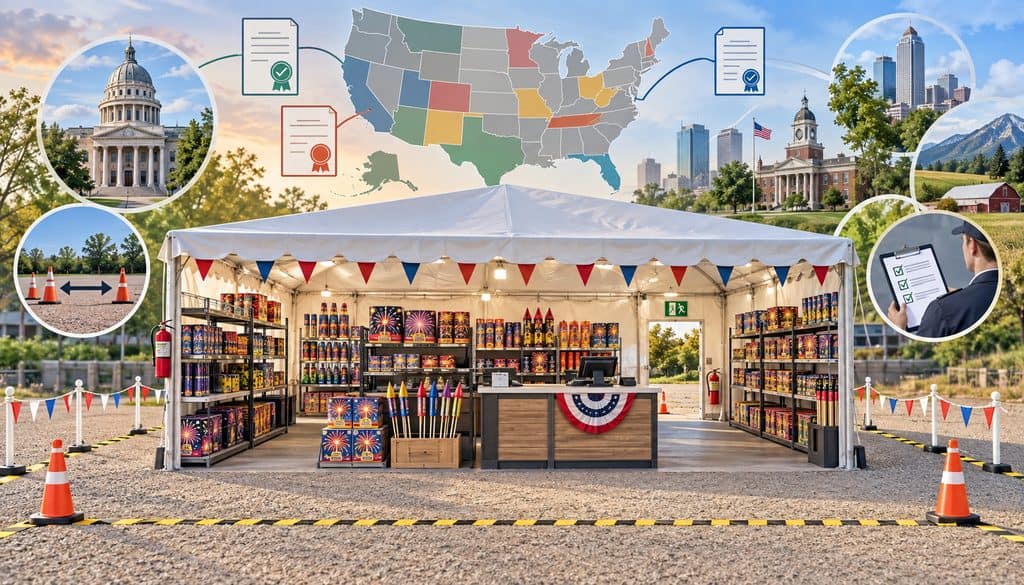
The phrase NFPA 1124 retail requirements needs particular care in 2026.
NFPA 1124 is a consensus code published by the National Fire Protection Association; it is not federal legislation that automatically binds every fireworks retailer.
More importantly, the current 2026 edition is titled Code for the Manufacture, Transportation, and Storage of Fireworks and Pyrotechnic Articles, and NFPA’s current materials exclude retail sales and related storage of consumer fireworks from its scope.
Historically, older NFPA 1124 editions included consumer-fireworks retail-sales provisions. Some jurisdictions continue to adopt one of those older editions by reference.
A useful example of jurisdiction-specific adoption comes from Kansas, where the State Fire Marshal’s current seasonal inspection materials incorporate requirements from the Kansas Fire Prevention Code and the 2006 edition of NFPA 1124.
This is why merchants should verify the edition actually adopted by their state or locality instead of assuming the newest NFPA publication automatically governs retail operations.
That creates an important rule for anyone researching fireworks retail license requirements by state:
Always verify the edition incorporated into governing law.
Do not assume:
- the newest NFPA publication is the edition adopted locally;
- a historical retail chapter remains part of the current NFPA code;
- every state follows NFPA 1124;
- an NFPA provision is binding merely because an inspector or application refers generally to “NFPA”;
- or a state-level adoption eliminates local amendments.
The official NFPA publication catalog confirms that a 2026 NFPA 1124 edition is now available alongside earlier editions.
What NFPA 1124 can cover at a high level
Where an older retail-sales edition has actually been incorporated into current law, the adopted provisions can affect matters involving consumer-fireworks retail facilities, temporary structures, fire protection, displays, separation concepts, and operational safeguards.
Those requirements should be obtained from the code edition and amendments adopted by the jurisdiction rather than reconstructed from internet summaries.
The distinction matters because NFPA 1124 retail requirements are only legally relevant to retail operations to the extent an applicable jurisdiction has preserved or incorporated those provisions.
Pro Tip: When an application says “NFPA 1124,” record the edition number in your compliance file. An edition reference can matter as much as the standard number itself.
Consumer 1.4G vs Display 1.3G Licensing
Product classification is another place where permit scope matters.
At the federal transportation-classification level, the U.S. Pipeline and Hazardous Materials Safety Administration identifies UN0336, Division 1.4G as consumer fireworks and UN0335, Division 1.3G as display fireworks. That distinction helps explain why a permit covering ordinary consumer retail sales should not be assumed to authorize display-fireworks activity.
ATF separately explains that display fireworks are subject to federal explosives licensing or permit requirements for certain commercial activities, while completed consumer fireworks receive different treatment under ATF’s explosives regulations and remain subject to other federal, state, and local regulation.
That federal classification context does not create a retail permit by itself. It helps explain why the products should not be treated as interchangeable when reviewing state or local licensing.
| Product Category | General Classification | Retail Permit Implication | What to Verify |
| Consumer fireworks | Commonly associated with DOT Division 1.4G / UN0336 | May fall within state/local consumer-retail licensing | Whether product is lawful in the jurisdiction and covered by the issued permit |
| Display fireworks | Often includes DOT Division 1.3G / UN0335 and other display classifications | Separate, more restrictive frameworks can apply | Federal, state, and local authority before any activity |
| Novelties or specially defined low-hazard products | Treatment varies by statute | May be exempt, separately defined, or included | Exact statutory definition |
| Proximate/theatrical pyrotechnics | Separate professional category | Ordinary retail permit should not be assumed sufficient | Applicable state, local, and professional requirements |
A consumer-fireworks retailer should therefore compare its actual inventory categories against the language of its permit rather than using “fireworks” as a catch-all description.
Consumer Fireworks Permit Deadlines and Seasonal Timing
There is no nationwide calendar of consumer fireworks permit deadlines.
Some states establish seasonal sales periods. Some application windows are controlled by a state agency. Others depend on local permitting offices, inspection availability, temporary-use procedures, or annual registration systems.
Tennessee demonstrates why current-year checking matters. The state normally describes seasonal retail periods as June 20–July 5 and December 10–January 2, but legislation created expanded sales periods for 2026 and early 2027 before reverting to the usual framework.
A merchant using last year’s compliance calendar could therefore be working from outdated assumptions even where the underlying business has not changed.
Kansas provides the opposite lesson. Because seasonal stand permits are handled locally, consumer fireworks permit deadlines must be obtained from the relevant local jurisdiction rather than inferred from the state’s seasonal sales dates.
Why seasonal permits need early filing
Opening depends on a series of tasks that frequently cannot be completed simultaneously:
Application → insurance → site review → inspection → permit issuance → processor document update → lawful opening
If step three is unresolved, step five may not happen. If the issued permit arrives shortly before opening, payment underwriting may still have an outdated document.
That is why prudent operators begin working on fireworks retail license requirements by state months before their peak period even when the statute itself does not require filing that early.
Early preparation should not be confused with an invented legal deadline. The only binding filing date is the one established by the controlling agency or law.
How to Complete a Fireworks Stand Permit Application
A fireworks stand permit application should be treated as a location-specific compliance package, not simply an administrative form.
Exact requirements vary, but a state or local application may ask for categories of information such as:
- legal business name;
- DBA or trade name;
- physical sales location;
- property-owner authorization;
- operating dates;
- responsible operator or manager;
- site or layout documents;
- evidence of state authorization;
- proof of insurance;
- and an inspection contact.
Do not assume all of those items apply everywhere. The current application issued by the actual authority should control.
| Document or Information | State/Local/Other | Why It May Be Needed |
| Entity record | State/local | Identifies permit applicant |
| DBA information | State/local | Connects storefront name with legal entity |
| Site address | Primarily local | Identifies location being authorized |
| Property authorization | Often local | Shows applicant may use the site |
| Site plan/layout | Jurisdiction-specific | Supports site/code review |
| State permit or registration | Local where applicable | Demonstrates state-level authorization |
| Certificate of insurance | Jurisdiction-specific | Evidence of required coverage |
| Inspection record | Fire authority | Documents site approval where required |
| Supplier information | Government or underwriting context | Supports lawful-source/business-activity review |
Temporary stand vs permanent retail store
A temporary stand should never be assumed to use the same procedure as a permanent fireworks store.
Kansas, for example, distinguishes seasonal retail stands from permanent fireworks retailers. Permanent retailers register annually with the State Fire Marshal and must operate in a building or structure with a permanent foundation; seasonal retail permits are handled locally.
A seasonal pop-up located inside an existing commercial building can create yet another question. The building’s existing occupancy approval or business license does not automatically prove that fireworks retail activity is permitted there.
Local zoning and temporary-use approval
A fire permit and a zoning approval answer different questions.
The fire authority may evaluate compliance with the applicable fire code. Planning or zoning officials may determine whether a temporary retail use is allowed on the parcel at all.
Accordingly, the fireworks stand permit application process should include a check for planning, zoning, building, or temporary-use requirements rather than assuming fire-department approval resolves every land-use issue.
If you are evaluating fireworks retail license requirements by state for a new site, verify the local land-use layer before committing to nonrefundable site costs.
Insurance Certificates and Site Inspections
Insurance is frequently part of the documentation chain, but requirements are jurisdiction- and policy-specific.
A licensing authority may require a certificate of insurance. A landlord may impose separate coverage requirements. A payment underwriter may also request proof of insurance as part of a broader risk review.
Do not infer a required coverage amount from another state’s application, another retailer’s COI, or an older permit file.
Where a COI is required, review basic consistency:
- Is the insured entity the business that actually operates the site?
- Is the policy currently effective?
- Is the correct location reflected when location identification is relevant?
- Can the DBA and legal entity be reconciled?
- Does the certificate correspond to the insurance policy being represented?
A naming difference is not necessarily improper. DBAs, subsidiary names, or other lawful structures can create legitimate differences. The point is that the relationship should be documented rather than leaving the licensing authority or underwriter to guess.
Site inspections before opening
A jurisdiction may require inspection before opening or as part of an ongoing licensing program.
Inspectors may evaluate compliance with the code, statute, permit conditions, approved site materials, or other requirements within their authority.
South Carolina’s official pyrotechnic-safety materials, for example, state that a deputy state fire marshal contacts applicants to schedule inspection and that retail operations may not begin before the required permit sticker has been obtained. The state also warns that its inspection guidelines are not an exhaustive substitute for applicable requirements.
If deficiencies are found, possible consequences can include correction requests, reinspection, or delayed approval. The appropriate response is to document corrections and follow the authority’s process.
Which Documents Payment Underwriters Ask For
Government licensing and payment underwriting serve different purposes.
The government determines whether the merchant is legally permitted to conduct the relevant activity.
A processor, acquiring bank, sponsor bank, or other payment provider determines whether it is willing to process that business under its risk policy and contractual framework.
Payment underwriting is a separate review from government licensing. During merchant-account underwriting, processors can evaluate business legitimacy, operating risk, financial information, processing history, and supporting documentation, while the government licensing authority determines whether the fireworks retailer is legally permitted to operate.
One approval does not guarantee the other.
A legally licensed fireworks seller can still be declined by a payment provider. Conversely, having a functioning payment terminal does not prove that the merchant has the legal authority to sell fireworks at the location.
Fireworks License for Merchant Account Underwriting
When an underwriter requests a fireworks license for merchant account approval, the safest interpretation is not “there must be one universal fireworks license.”
The provider is usually trying to verify that the merchant is properly authorized for its actual business, products, and locations. Depending on the account and provider, the relevant proof could include state authorization, location-specific local permits, current business licensing, inspection records, insurance, or additional supporting documents.
Requirements vary by processor and underwriting relationship.
| Document | Why Processor May Ask | Renewal/Update Trigger |
| State fireworks license/registration | Evidence of state-level legal authorization | Expiration, renewal, entity change |
| Local permit | Evidence that specific location may operate | Seasonal renewal, new address |
| General business license | Helps establish entity/local operation | Renewal or jurisdiction change |
| COI | Insurance evidence where relevant | Policy renewal or coverage change |
| Inspection/operating approval | Supports proof of lawful site operation | New inspection or permit cycle |
| Supplier invoice | Supports stated product line and legitimate business activity | New review or material product change |
| Entity documents | Connect permit holder to merchant account | Ownership/entity change |
| Location list | Shows where approved processing occurs | Stand opening, closure, relocation |
The merchant should therefore avoid sending only an expired prior-season fireworks license for merchant account review and assuming the underwriter will discover the new permit independently.
If the business has been inactive for several months, review whether the seasonal merchant account may require updated information before processing resumes. Current permits, locations, expected sales activity, and business details should be ready if the processor conducts a renewed underwriting review.
Why underwriters may request supplier invoices
Supplier invoices can help an underwriter understand whether the merchant’s actual commercial activity matches what was disclosed.
They may support questions such as:
- What is the merchant actually selling?
- Does inventory appear consistent with the approved business model?
- Is the merchant operating as a retailer or engaging in another activity?
- Has the product mix materially changed?
Kansas itself demonstrates why invoices can have regulatory relevance beyond payment underwriting. Its State Fire Marshal instructs seasonal retailers to maintain inventory records identifying the Kansas-permitted distributor and says retailers purchasing directly for their own stands should retain invoice copies showing where the fireworks came from.
That does not mean every processor requires supplier invoices. It demonstrates why retaining them is sensible compliance-file practice.
Processor documentation questions to settle before opening
Ask the processor or acquiring institution in writing:
- Which licenses and permits must be supplied?
- Does each stand or store require separate location documentation?
- Is a current COI required?
- Are supplier invoices required?
- Are temporary locations configured separately in the processing system?
- How should renewed permits be submitted?
- What is the procedure for adding a new location?
- What happens if required licensing expires?
- Which documents must be refreshed annually?
Location changes, expired permits, and inconsistent business details can become part of broader payment-processing challenges for fireworks retailers. Keeping the processor’s records synchronized with current licenses and operating addresses can reduce avoidable questions during a risk review.
What Happens When a Permit Expires or Rules Change Mid-Season
A permit expiration creates two different issues.
First, the business must determine whether it still has lawful authority to conduct fireworks retail activity. A merchant should not continue a regulated activity that is no longer authorized merely because a payment terminal remains operational.
Second, a licensing lapse may become a merchant-account issue. Depending on the provider, merchant agreement, acquiring relationship, and circumstances, the processor may request updated documentation, place the account into review, restrict certain activity, or take other contractual action.
There is no universal rule that an expired permit automatically freezes every fireworks merchant account.
However, it is unsafe to assume the opposite—that payment approval continues regardless of licensing status.
This is where fireworks retail license requirements by state become an ongoing compliance responsibility rather than an opening-day task.
Do not wait for a risk review
Document renewal should be proactive.
If a permit or insurance document is approaching expiration, update it before the old copy becomes stale. This is especially important for businesses that keep a seasonal merchant account through the off-season, because refreshed underwriting may occur before or when processing activity resumes.
If a state or local rule changes mid-season
Legal changes can occur after the season has started. Emergency restrictions, local orders, statutory changes, permit suspensions, or changes affecting particular product categories can alter what the merchant may lawfully sell.
A conservative compliance response is:
- Confirm the change from the issuing government authority.
- Identify affected locations and product categories.
- Stop any activity that has become prohibited or unauthorized.
- Preserve the official notice and related records.
- Notify the insurer and processor when the change materially affects information previously provided to them.
- Update merchant and product profiles through authorized procedures where necessary.
Do not rely on social-media summaries or another retailer’s interpretation of an emergency order.
If the change affects anticipated processing volume as well as legal operations, the business may also need to revisit its seasonal payment-volume assumptions before continuing substantial card activity.
Multi-State and Multi-Location Compliance
Multi-location merchants should build a permit matrix rather than a single company-level checklist.
A license issued in State A does not authorize sales in State B. Even within the same state, two municipalities can impose different local procedures.
Fireworks retail license requirements by state therefore represent only the first axis of the matrix. The second is location.
As of September 14, 2026, current official materials illustrate several different models:
- Kansas: temporary seasonal stand permits are handled locally, while permanent retailers register annually with the State Fire Marshal. Kansas identifies the 2006 NFPA 1124 edition for seasonal retail-stand technical requirements.
- Tennessee: seasonal retailers obtain state permits for each retail sales location, with local executive signoff required in applicable jurisdictions. The state also modified its usual seasonal sales periods for 2026 by temporary legislation.
- Pennsylvania: consumer fireworks facilities are licensed through the Pennsylvania Department of Agriculture under the state’s current fireworks law; the state directs sellers to its consumer-fireworks facility licensing process.
This is intentionally not a 50-state chart. A comprehensive matrix should not be published unless every row is verified against current official authority.
| Location | State Permit | Local Permit | Inspection | COI | Underwriting Status |
| Stand A | Record actual status | Record actual status | Record actual status | Current/required? | Submitted/approved/pending |
| Stand B | Record actual status | Record actual status | Record actual status | Current/required? | Submitted/approved/pending |
| Store C | Record actual status | Record actual status | Record actual status | Current/required? | Submitted/approved/pending |
One legal entity, multiple sites
A company can centralize accounting, ownership, banking, insurance administration, and corporate records while still needing separate permits for individual locations.
The payment profile should also reflect the merchant’s real operating footprint. When a company adds or removes stands, its seasonal fireworks merchant-account configuration should be updated to match current locations rather than relying on addresses carried forward from a prior season.
DBA and license-name matching
The following records should be readily reconcilable:
- legal entity;
- DBA;
- state license holder;
- local permit holder;
- insurance named insured;
- settlement bank relationship;
- merchant account;
- physical location.
They do not necessarily have to display identical text in every jurisdiction. A lawful DBA, subsidiary, or other documented structure can create differences.
The goal is to make the relationship clear.
Central compliance file
Maintain one controlled repository containing:
- entity formation records;
- current state fireworks approvals;
- municipal and county permits;
- zoning or temporary-use approvals where applicable;
- certificates of insurance;
- inspection records;
- supplier documentation;
- renewal and expiration dates;
- official correspondence;
- and processor underwriting communications.
A current file is far more useful than a folder containing five years of unlabeled permit PDFs.
Pre-Season Compliance Calendar Working Back From July 4th
The following schedule is illustrative planning guidance only. It is not a statement of statutory consumer fireworks permit deadlines.
Actual filing dates must come from the state, county, municipality, and other competent authorities for the intended location.
| Time Before Peak | Compliance Task | Underwriting Task |
| 120–180 days | Map jurisdictions; identify state/local agencies; review law/code changes; begin insurance planning | Review merchant profile, locations, ownership, products |
| 90–120 days | Begin filings when agencies permit; collect site/property records | Gather permits, COIs, entity records requested for review |
| 60–90 days | Complete outstanding applications; coordinate inspections where required | Submit available updated licensing documentation |
| 30–60 days | Resolve deficiencies; follow up on pending permits | Verify underwriter has correct addresses and current documents |
| Final 30 days | Confirm issued permits and operating authorization; check current official notices | Confirm processing file is current and location configuration is correct |
| During season | Track expiration and legal changes | Submit renewed documents and material updates promptly |
Planning 120–180 days ahead does not mean every agency accepts applications that early. It means the merchant should already understand the process and dependency chain.
Why July 4th backward planning matters
A late fireworks stand permit application can create more than a licensing inconvenience.
Suppose the local permit depends on a completed site review. The inspection cannot occur until the stand is erected. The payment underwriter wants the issued location permit. The merchant plans to open several days before July 4th.
Now four separate workflows depend on one another.
That is why fireworks retail license requirements by state belong in the operational calendar alongside insurance, site control, staffing, banking, and payment readiness.
A business that begins permit research in late June may discover that the problem is not completing a form. It is finding enough time for several organizations to finish sequential work.
Common Fireworks Licensing Mistakes
Most licensing failures are not caused by an inability to find a business-registration form. They occur when one approval is mistaken for another.
| Mistake | Legal/Operational Risk | Better Approach |
| Assuming LLC/business registration equals a fireworks permit | Retail activity may remain unauthorized | Identify specific fireworks authorization |
| Assuming state approval replaces local approval | Site may lack zoning/fire authorization | Check county and municipality separately |
| Treating NFPA 1124 as universally applicable | Wrong code/edition may be used | Verify adopted code and edition |
| Filing too late | Inspection or approval may miss opening date | Work backward from target opening |
| Missing insurance documents | Application may remain incomplete where COI is required | Coordinate insurance early |
| Using last year’s permit in underwriting | Processor file may contain expired proof | Send current issued documents |
| Failing to report new stand location | Merchant profile may not reflect actual operations | Use processor’s location-update process |
| Ignoring permit expiration | Legal authority can lapse | Track expiration centrally |
| Treating 1.4G and 1.3G as interchangeable | Wrong regulatory framework may be applied | Verify product classification and permit scope |
| Reusing old supplier/compliance files | Current activity may not be documented | Archive by season and maintain current records |
Another common mistake is treating licensing and payment compliance as unrelated. In practice, seasonal payment-processing challenges can become more difficult when permit, address, or business records are inconsistent, particularly during a peak-season account review.
Another is treating an issued permit as a permanent credential. Seasonal permits, annual registrations, insurance policies, locations, and merchant-account documentation change.
Fireworks Retail Licensing and Underwriting Checklist
Use this as an operational control list, then replace each general item with the actual requirement for the jurisdiction.
- Identify every operating state.
- Identify every physical sales location.
- Confirm consumer/display product category.
- Identify the state licensing authority.
- Identify the county/city authority.
- Verify current state law.
- Verify the adopted local fire code.
- Determine whether any older NFPA 1124 retail provisions are incorporated.
- Confirm actual permit deadlines.
- Gather entity documents.
- Gather property/site documents.
- Renew insurance.
- Submit state application where required.
- Submit local application where required.
- Schedule inspections where required.
- Correct documented deficiencies.
- Obtain final permits.
- Store current copies centrally.
- Track expiration dates.
- Send required license and permit documents to the processor.
- Send current COI where requested.
- Maintain supplier documentation.
- Confirm processor records match current legal entity and locations.
- Monitor legal changes during the season.
- Update the processor promptly when licensing status materially changes.
Renewal season workflow
A more formal annual procedure can reduce missed steps:
- Pull prior-year permits and applications.
- Verify current statutory and regulatory changes.
- Confirm the current state agency.
- Confirm every local permitting authority.
- Revalidate each property and sales site.
- Renew or update insurance as appropriate.
- Submit current applications.
- Schedule required inspections.
- Resolve documented deficiencies.
- Save issued permits and inspection records.
- Send required documents to the payment underwriter.
- Confirm the underwriting file reflects current locations.
- Open only when legally authorized.
- Track permit and insurance expiration throughout the season.
The renewal process should never consist of changing the year on last season’s checklist.
Practical Pre-Season Compliance Workflow
For operators managing several agencies and multiple payment records, the following 21-step sequence provides a repeatable control framework.
- Identify every planned sales location. Use the actual physical address, not merely the city or sales territory.
- Identify the applicable state. Do not assume a nearby location across a state boundary follows the same process.
- Identify the state licensing authority. Confirm whether it is the fire marshal or another department.
- Identify county and city authorities. Check fire prevention, zoning, planning, temporary-use, and licensing responsibilities.
- Confirm product category. Establish whether the proposed retail activity involves consumer fireworks or another regulated category.
- Verify current state and local law. Use current government sources rather than last season’s notes alone.
- Verify adopted fire-code references. Record the code, edition, and amendments where relevant.
- Review actual statutory or agency deadlines. Do not substitute an internal planning date.
- Gather entity documents. Ensure the legal applicant is clear.
- Gather site/property documents. Obtain what the actual application requires.
- Renew insurance. Coordinate timing so required evidence is current when submitted.
- Submit applications. Follow state and local procedures independently where necessary.
- Schedule inspections. Use the authority’s process.
- Correct deficiencies. Preserve written evidence of correction or reinspection.
- Obtain final licenses and permits. Do not treat an application receipt as an issued authorization.
- Store copies in the central compliance file.
- Submit required records to the payment underwriter. A fireworks license for merchant account review may consist of several documents rather than one certificate.
- Confirm the payment file matches current locations.
- Track renewals and expirations. Include state permits, local permits, inspections, and insurance.
- Monitor mid-season changes. Watch official state and local notices.
- Preserve records after the season. They provide a useful starting point for the next renewal and can help reconstruct what authority existed during a particular operating period.
This workflow turns fireworks retail license requirements by state into a controlled business process rather than a last-minute licensing search.
Frequently Asked Questions
What licenses does a fireworks retailer need?
The answer depends on the jurisdiction and sales location. A retailer may need a state fireworks permit or registration, local fire or temporary-use approval, zoning or business licensing, insurance documentation, and inspection approval. A general business registration alone should not be treated as authorization to sell fireworks.
Do fireworks retail license requirements vary by state?
Yes. Fireworks retail license requirements by state differ substantially in both substance and administration. Some states issue retail permits centrally, while others delegate substantial responsibility to counties or municipalities. Local overlays can also differ within one state.
Is a state fire marshal permit enough to open a fireworks stand?
Not necessarily.
A state fire marshal retail fireworks permit may satisfy one layer, but local zoning, temporary-use, fire prevention, building, business-license, or inspection requirements may still apply. Verify the intended site’s municipal and county requirements separately.
What is NFPA 1124?
NFPA 1124 is an NFPA consensus code concerning fireworks and pyrotechnic articles. The current 2026 edition covers manufacture, transportation, and storage.
Older editions contained consumer-retail provisions, and some jurisdictions still incorporate an older edition. Therefore, references to NFPA 1124 retail requirements must identify the edition adopted by the governing jurisdiction.
Does every state follow NFPA 1124?
No.
NFPA 1124 is not automatically binding nationwide. A jurisdiction must adopt or otherwise incorporate applicable provisions through its legal framework before those provisions become controlling law there. Even where NFPA 1124 is referenced, the edition and amendments matter.
What is the difference between 1.4G and 1.3G fireworks?
DOT terminology commonly associates UN0336 Division 1.4G with consumer fireworks and UN0335 Division 1.3G with display fireworks. The classifications have different regulatory implications. A consumer-retail permit should never be assumed to authorize display-fireworks activities.
When should I apply for a seasonal fireworks permit?
Use the deadline published by the actual issuing authority.
Operationally, begin researching requirements months before opening because consumer fireworks permit deadlines, insurance, site review, inspections, and underwriting updates can depend on one another. The illustrative 120–180-day schedule in this article is planning guidance, not a statutory deadline.
What documents are usually required for a fireworks stand permit application?
A fireworks stand permit application may request entity information, the physical sales address, property authorization, operating dates, site documents, insurance information, state-license references, and inspection contact information. The exact application controls. Do not assume another jurisdiction’s checklist applies.
Do fireworks retailers need liability insurance?
Insurance requirements vary.
A government authority, landlord, processor, or other counterparty may require evidence of coverage, but required policy types, limits, endorsements, and certificate details should never be assumed from a generic checklist.
Is a site inspection required before opening?
It depends on the jurisdiction and permit type.
Where an inspection is required, the retailer should treat successful completion and any resulting operating approval as part of the pre-opening dependency chain rather than assuming submission of the permit application is sufficient.
What fireworks license will a merchant-account underwriter ask for?
There is no universal fireworks license for merchant account underwriting.
A provider may request whatever state and local documents establish that the merchant is legally authorized for the products and locations being underwritten. It may also request entity records, a COI, supplier invoices, or other evidence depending on its risk policy.
Why would a processor request supplier invoices?
Supplier invoices can help verify the merchant’s actual line of business and product mix and can support the underwriter’s review of whether commercial activity matches the information supplied during onboarding. Not every provider asks for them, so requirements should be confirmed directly with the processor.
What happens if my fireworks permit expires during the season?
First determine immediately whether the business remains legally authorized to sell.
The processor may also request renewed documentation or review the account. Possible processor actions depend on the provider and merchant agreement; a universal automatic account freeze should not be assumed.
What should I do if a state or local rule changes mid-season?
Confirm the change from the responsible government authority, identify affected products and locations, stop prohibited or unauthorized activity, preserve relevant notices, and update insurers or payment providers when the change materially alters information they rely upon. Do not rely on methods intended to circumvent the restriction.
How early should I start preparing for July 4th licensing?
Research should generally begin months ahead so there is time to identify authorities, compare this year’s rules with last year’s records, obtain insurance documentation, complete a fireworks stand permit application, resolve inspection issues, and update payment underwriting.
Actual consumer fireworks permit deadlines remain jurisdiction-specific and always take precedence over an illustrative planning calendar.
Conclusion
Fireworks retail licensing is a layered state-and-local process, not a single business-registration task. A merchant can have a properly formed company and still lack authorization to sell fireworks from a particular temporary stand or permanent store.
State permits do not automatically replace municipal approvals, zoning reviews, or location-specific fire requirements. NFPA 1124 also requires careful treatment: the current 2026 edition no longer contains the historical consumer-retail framework, while some jurisdictions still incorporate older NFPA 1124 editions containing retail provisions. The controlling law and adopted edition must therefore be verified for each location.
Consumer and display fireworks likewise should not be treated as interchangeable regulatory categories.
For seasonal operators, the safest operational model is to begin months before July 4th: identify every jurisdiction, verify the actual application deadlines, obtain current insurance and inspection records, secure final permits, and keep those documents synchronized with the processor’s underwriting file.
Payment providers do not enforce fire codes, but they may require evidence that the business they are underwriting is lawfully licensed for its products and locations. Permit expirations, new locations, legal changes, or material product changes should therefore be addressed promptly rather than left for a processor risk review to discover.