
By Shelly Graves August 19, 2026
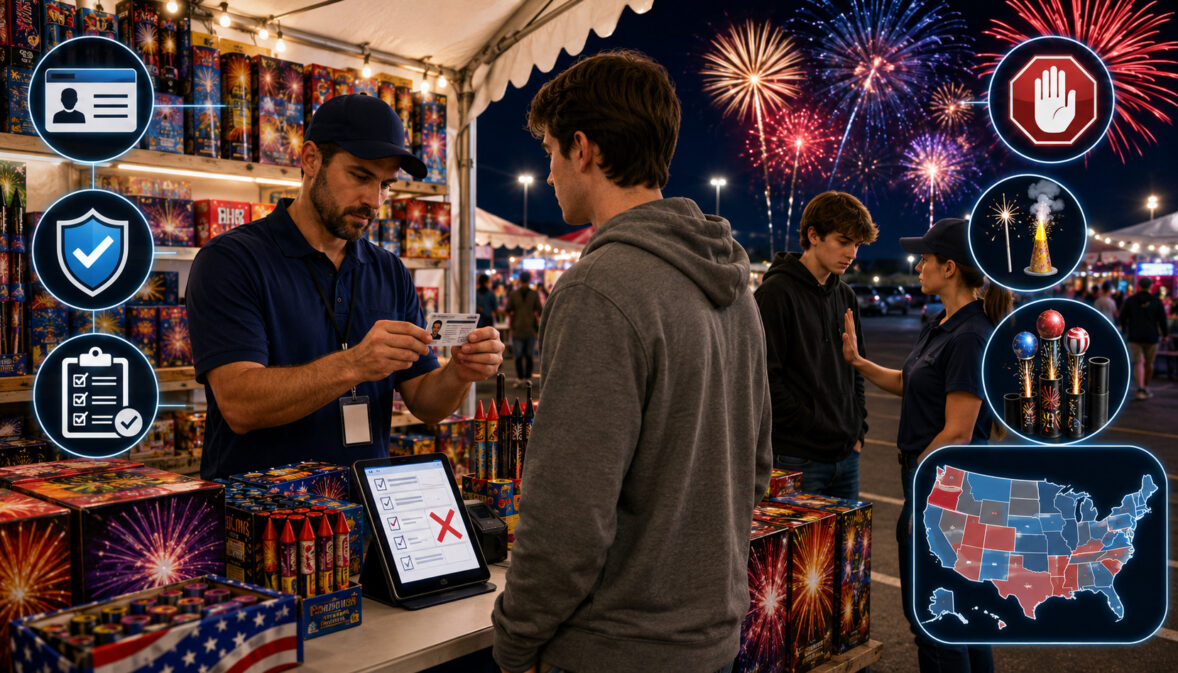
A fireworks retailer can have a legal product on the shelf and still make an unlawful sale if the customer does not meet the applicable age requirement or if the product falls into a more restricted category.
That is why age verification at a fireworks tent cannot be reduced to a cashier asking, “Are you 18?” The correct compliance decision depends on the product, the exact sales location, state and local law, the customer’s eligibility, and sometimes permits or other restrictions.
A defensible retail process connects each step:
Product Classification → Applicable State/Local Rule → Age Threshold → ID Check → Sale or Refusal → Documentation
There is no single nationwide fireworks purchase legal age that a retailer should apply to every product in every jurisdiction.
Federal agencies regulate important aspects of fireworks manufacturing, product safety, explosives, transportation, and display fireworks, but state and local governments often determine which consumer products may be sold, who may buy them, where sales may occur, and when those sales are permitted.
The U.S. Consumer Product Safety Commission specifically advises consumers to make sure fireworks are legal in their area and to purchase products labeled for consumer, rather than professional, use.
For seasonal retailers, this creates an operational challenge. A cashier may work only a few weeks each year, while the rules can involve multiple product classes, temporary permits, local ordinances, seasonal sales windows, and different purchaser-age requirements.
The answer is not to expect every cashier to become a lawyer. It is to build a current, location-specific retail fireworks age policy that turns verified legal requirements into a short, repeatable checkout procedure.
This guide provides a framework for doing that. It is general educational information for fireworks retailers and does not constitute individualized legal advice. Fireworks operators should verify applicable requirements with the relevant state fire marshal, licensing agency, municipality, fire department, and qualified counsel before selling.
Consumer Fireworks vs. Display Fireworks
The first question in any fireworks age verification program should not be “How old is the buyer?” It should be “What type of product is being sold?”
Federal regulations and state laws distinguish consumer fireworks from products intended for professional displays. Those categories should never be treated as interchangeable inventory.
The Bureau of Alcohol, Tobacco, Firearms and Explosives describes consumer fireworks as the smaller fireworks commonly sold at seasonal stands.
ATF identifies completed consumer fireworks as DOT classifications UN0336 or UN0337 and notes that ATF generally does not regulate the importation, distribution, or storage of completed consumer fireworks, although other federal, state, and local authorities do.
The CPSC separately regulates fireworks sold to consumers under federal product-safety requirements, including construction, performance, composition, and cautionary-labeling rules. Certain fireworks that fail applicable requirements are banned hazardous substances.
Display fireworks occupy a much more restricted regulatory environment. ATF describes display fireworks as the large fireworks commonly used in shows under the supervision of trained pyrotechnicians.
Display fireworks generally fall under DOT classifications UN0333, UN0334, or UN0335, and federal explosives licensing, permitting, storage, and related requirements can apply.
A third category also matters: novelty or exempt products. State statutes may treat items such as certain sparklers, party poppers, snakes, snappers, toy caps, or similar devices differently from consumer fireworks. A product being called a “novelty,” however, is not enough. Retailers should use the applicable statutory or regulatory definition in their jurisdiction.
Consumer vs. Display Fireworks Rules
| Issue | Consumer Fireworks | Display/Professional Fireworks |
| Typical retail availability | May be sold to consumers where state and local law permits the specific product and seller | Not ordinary fireworks-tent retail inventory |
| Buyer restrictions | State and local purchase-age, product, location, date, and other restrictions may apply | Transactions can involve federally regulated explosives activities, qualified operators, permits, and other restrictions |
| Licensing/permit considerations | Retail licenses, seasonal permits, location approvals, or registrations may be required by state/local authorities | Federal explosives licenses or permits can apply, along with state and local display/operator approvals |
| Storage/handling controls | Controlled by applicable consumer-product, fire, building, state, and local rules | Subject to significantly more restrictive explosives storage and safeguarding requirements |
| Typical seller environment | Licensed or otherwise lawful retail store, stand, tent, or facility where permitted | Specialized explosives businesses and professional display operations |
ATF states that a person engaging in the business of importing, manufacturing, or dealing in display fireworks, or receiving or transporting them as regulated explosives, must obtain the appropriate federal explosives license or permit for the activity. ATF regulations also contain specific storage requirements for displaying fireworks.
Is There a Universal Age to Buy Fireworks?
No. A universal minimum age to buy fireworks should not be assumed in the United States.
States can establish different fireworks sales age requirements, and those requirements may interact with product classifications, possession restrictions, retailer licenses, local ordinances, and permitted sales locations. Local governments may also impose additional restrictions where state law allows them to do so.
For example, Washington law currently prohibits a fireworks licensee from selling fireworks to a person under 16. The same law requires consumer fireworks sales to occur at a licensed and permitted fixed place of business.
Pennsylvania provides a different example. The Pennsylvania State Police currently state that persons 18 and older may purchase, possess, and use consumer fireworks, while professional display fireworks require a municipal permit and professional use.
The Pennsylvania Department of Agriculture also states that consumer fireworks may be purchased only through licensed facilities under the state’s regulatory framework.
Ohio law provides another variation. Ohio Revised Code § 3743.65 prohibits selling fireworks of any kind to a person under 18 and contains additional restrictions affecting minors on licensed fireworks premises.
These examples illustrate why a generic internet chart is not enough for a seasonal cashier.
The consumer fireworks age limit applicable to one location may not be the rule at another location, and the minimum purchase age is only one part of the analysis. A state could allow certain consumer products while prohibiting others, impose restrictions on where sales occur, require seller permits, or authorize local governments to impose additional controls.
Retailers should also distinguish among:
- minimum age to purchase;
- minimum age to possess or use;
- requirements for adult supervision;
- restrictions on particular product classes;
- rules governing access to licensed premises; and
- seller-specific licensing or permit obligations.
An age-check policy should therefore be based on verified rules for the specific retail site rather than a nationwide assumption.
State Fireworks Age Restrictions: Build a Verified Compliance Matrix
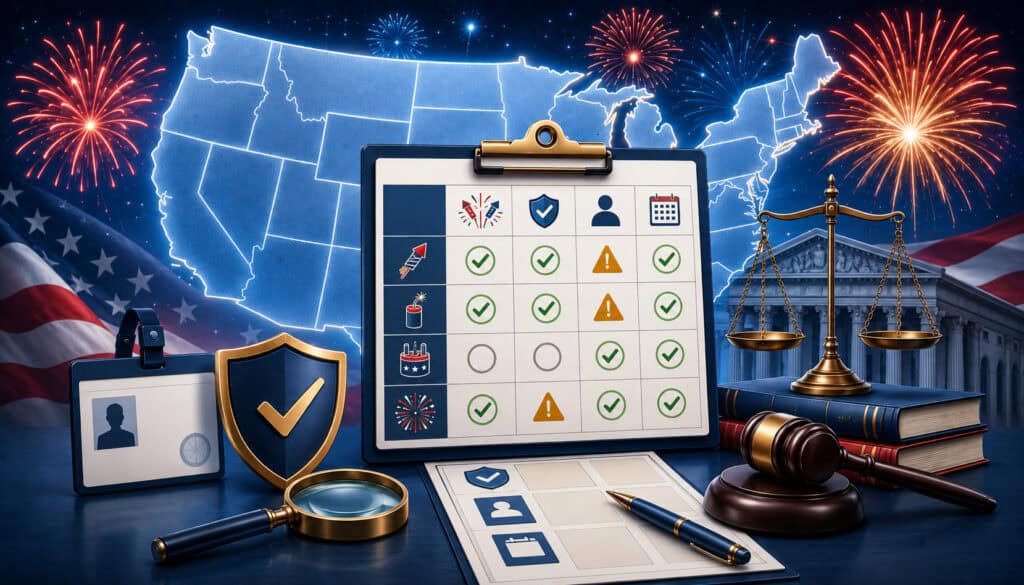
A practical way to manage state fireworks laws age restrictions is to maintain a compliance matrix for every jurisdiction in which the business sells.
Do not build the matrix by copying a commercial 50-state summary and assuming it remains accurate. Use the summary only as a research lead, if at all. Each operational row should ultimately point to a current government source.
The best starting points usually include the state fire marshal, legislature or administrative-code website, state police or public-safety agency, department responsible for fireworks seller licensing, and the local government where the tent or store will operate.
For every selling location, verify at least:
| State/Jurisdiction | Consumer Fireworks Allowed? | Minimum Purchase Age | Local Variance? | Seller Permit? | Official Source | Last Verified |
| Location A | Verify | Verify | Verify | Verify | Government URL | Date |
| Location B | Verify | Verify | Verify | Verify | Government URL | Date |
The “Last Verified” field is critical. Fireworks laws, sales windows, local restrictions, permit procedures, and enforcement guidance can change between seasons.
What Each State-Law Review Should Confirm
A complete fireworks vendor compliance review should identify more than the minimum buyer age. For every state or locality, confirm:
- Which consumer fireworks are lawful to sell.
- Whether particular products fall into different categories.
- The minimum purchaser age.
- Whether the statute expressly requires identification.
- Whether minors face separate possession or use restrictions.
- Whether retailers need a license, registration, or temporary permit.
- Where sales may occur.
- Whether sales are limited to particular dates.
- Whether municipalities, counties, or fire districts may impose stricter rules.
- Whether special permits apply to specific products or activities.
- Whether local fire inspection, zoning, storage, or signage requirements apply.
- What records the retailer is legally required to maintain.
Texas demonstrates why sales dates and permits belong in the same matrix as age rules. Its fireworks statutes establish retail fireworks permit requirements and specific authorized sales periods, including some periods that depend on county action.
A retailer therefore cannot conclude that a transaction is lawful simply because the buyer satisfies an age threshold.
State Law vs. Local Fireworks Rules
State permission does not always mean a fireworks tent can sell every state-permitted product at every location.
Cities, counties, municipalities, fire districts, and other local authorities may regulate fireworks differently, depending on powers granted under state law. They may restrict sales, use, dates, locations, permits, fire-safety conditions, or particular product categories.
Phoenix provides a useful example of why operators must verify the exact address. The city’s official fireworks guidance explains that Phoenix Fire Code restrictions interact with Arizona state law and identifies state-authorized sales and use periods for permissible consumer fireworks.
The city also distinguishes permissible products from prohibited aerial fireworks and directs retailers and consumers to current state law for controlling requirements.
Pennsylvania likewise advises consumers to check with their municipality for applicable local ordinances. For a seasonal operator, the practical rule is simple: research the tent address, not merely the state.
That means verifying the legal requirements for the parcel or municipality where the sale actually happens. When a business operates multiple tents, each location should have its own compliance file.
A location file should contain the current seller permit, fire inspection documentation where required, applicable sales dates, product restrictions, purchaser-age rule, ID policy, local contacts, and copies or links to controlling government sources.
If a county rule differs from a neighboring municipality, the company should not expect temporary employees to remember the distinction. The register instructions and signage should reflect the rules for that specific location.
Retailers should also review changes shortly before opening. A permit issued months earlier does not necessarily establish that every product or sales practice remains permissible.
Building a Fireworks Tent ID Policy
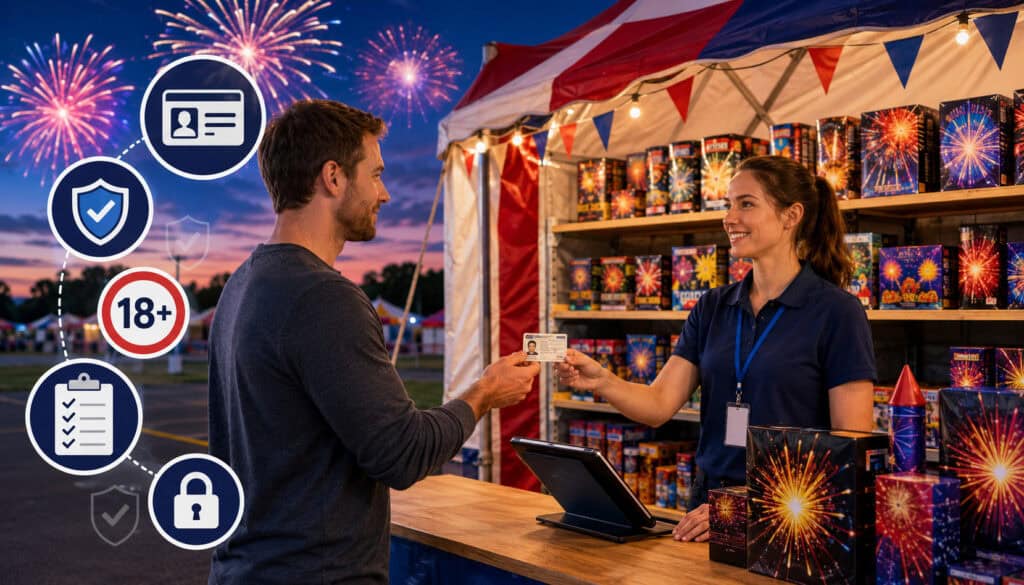
A good fireworks tent ID policy should turn complicated legal research into a straightforward decision tree.
The written policy should identify the actual legal minimum purchase age for the products sold at that location, then establish when employees must request identification. Some retailers may adopt a conservative appearance-based ID policy, such as checking anyone who appears below a company-selected age, where that practice is lawful.
The company threshold should never be confused with the legal age. If the legal purchase age is 18 and the store checks anyone who appears under 30, for example, 30 is an ID-check trigger, not the minimum age to buy fireworks.
A workable checkout sequence is:
- Identify the product category: Confirm that the merchandise is authorized consumer inventory for that location.
- Apply the correct age threshold: Use the location’s current compliance matrix.
- Request identification when the store policy requires it.
- Inspect the document: Compare the photograph, date of birth, expiration status, visible integrity, and customer.
- Resolve uncertainty: Send questionable cases to a designated supervisor.
- Complete or refuse the transaction.
- Record the refusal when required by policy.
- Do not retain unnecessary ID information.
- Never allow a manager to override a legal prohibition.
The policy should also state what happens when a customer has no ID, presents a document that does not meet store policy, or attempts to purchase a restricted category of merchandise.
Consistency matters. Employees should not decide who receives an age check for fireworks according to race, ethnicity, gender, clothing, accent, disability, or other unrelated characteristics.
The strongest policy gives employees objective criteria and a short escalation process.
What IDs Should a Fireworks Retailer Accept?
Common age-verification documents can include a government-issued driver’s license, state identification card, passport, and, where lawful and operationally appropriate, military identification.
That does not mean every jurisdiction legally requires or accepts exactly those documents. Fireworks statutes do not always specify an exhaustive list of acceptable IDs, and other laws or merchant policies may affect document handling.
The retailer should therefore establish an acceptable ID for fireworks purchase policy after reviewing applicable law. The written policy should define acceptable document categories, whether physical documents are required, how digital credentials are handled where available, and when a supervisor must review an unusual document.
Employees should not invent exceptions because the customer is familiar, says they forgot their wallet, shows a photograph of an ID when the policy requires the original, or has another person vouch for their age.
The objective is predictable enforcement.
What About an Expired ID?
An expired ID fireworks sale question should be addressed before the season begins, not improvised during a busy holiday rush.
Whether an expired credential is legally sufficient can depend on the applicable statute, regulation, government guidance, and the nature of the identification requirement. When the law does not resolve the issue directly, the retailer can adopt a reasonable written merchant policy consistent with applicable law and counsel’s guidance.
Cashiers should receive a yes-or-no operating rule for ordinary situations and an escalation path for exceptions.
The same rule should be applied consistently. One cashier should not reject expired licenses while another accepts them because the customer “looks old enough.”
How Staff Should Perform Fireworks ID Verification
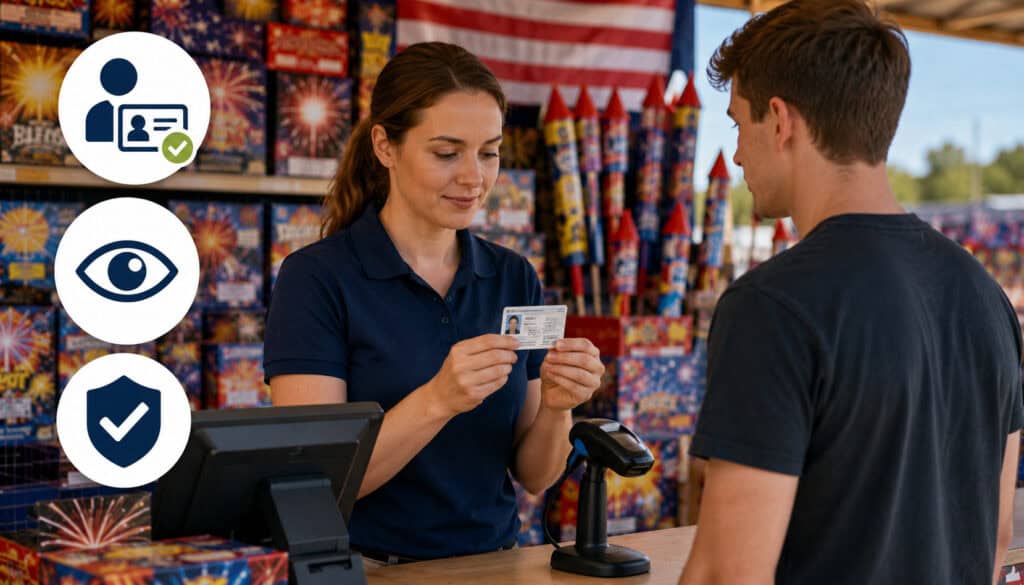
Fireworks ID verification should be simple, physical, consistent, and defensive.
When an ID check is required, the employee should examine the document rather than relying on the customer to read a date aloud. The employee should verify enough information to make the age decision without collecting more data than necessary.
A routine check should include:
- photograph;
- date of birth;
- expiration date;
- basic consistency between the person and the document;
- obvious signs that the credential has been altered or damaged; and
- overall document integrity.
Employees do not need training that teaches sophisticated methods of reproducing or defeating identity documents. Training should focus on recognizing ordinary warning signs and knowing when to stop the transaction.
If the photograph clearly does not correspond to the customer, the document appears materially altered, or the employee cannot reasonably determine that the policy has been satisfied, the transaction should move to supervisor review or refusal under the company’s written procedure.
Cashiers should avoid accusing customers of possessing fraudulent identification. The employee’s role is generally to determine whether the retailer can complete the transaction under applicable law and policy.
A statement such as “I can’t complete this sale with the identification presented” is usually more appropriate than an unsupported accusation of forgery.
Fireworks retail training should also include date-of-birth calculation. A POS prompt or age-calculation tool can reduce arithmetic errors, but employees should understand which legal threshold they are enforcing.
ID Scanners and Age-Verification Technology
Age-verification technology can improve consistency by calculating age, prompting employees, recording that a check occurred, and reducing mistakes during high-volume periods.
It does not eliminate employee judgment.
A scanner may read a valid data format while the document belongs to someone else. Employees still need to compare the photograph and customer and follow the business’s policy when something does not match.
Retailers should also evaluate privacy before deploying scanners. Determine what data the device reads, what the software sends to a third party, what information is retained, how long it remains available, who can access it, and whether applicable law restricts scanning or retention.
A useful system may record that an age check passed without permanently storing the customer’s full license number, address, date of birth, or ID image.
Technology should support fireworks retail ID verification, not become an uncontrolled customer-data archive.
Privacy and Fireworks ID Data
Age verification and identity-data collection are different activities.
A retailer may need to establish that a customer meets the applicable purchasing requirement without needing to retain a copy of the customer’s identification. That distinction is particularly important when developing a fireworks refusal log.
Unless applicable law, a regulator, or qualified counsel requires more, businesses should consider data minimization as a default operational principle.
Avoid putting the following information into an ordinary refusal log without a legitimate requirement:
- full driver’s-license or identification number;
- photograph or scan of the ID;
- customer’s complete date of birth;
- residential address;
- passport number;
- photocopy of the credential;
- unnecessary payment-card information.
Instead, record the operational event: when the refusal occurred, which location and register were involved, what general product category was requested, why the sale was refused, which employee handled it, and whether a supervisor became involved.
That information can support training and internal review without turning a compliance log into a database of customer identifiers.
Retailers using third-party age-verification technology should separately review vendor contracts, privacy notices, access controls, data-retention settings, security practices, and state-specific privacy requirements.
The principle is straightforward: collect what the compliance process genuinely needs and avoid retaining unrelated personal data simply because the technology makes collection possible.
When a Fireworks Sale Should Be Refused
A fireworks sale should be refused whenever the retailer cannot lawfully complete it or the customer fails the retailer’s lawful verification policy.
Common refusal scenarios include:
- the customer is below the applicable purchaser age;
- the customer does not provide acceptable identification when store policy requires it;
- the ID clearly does not correspond to the person presenting it;
- the ID appears materially altered or otherwise unacceptable under policy;
- the requested product cannot legally be sold to that customer;
- the product is not lawful retail inventory at that location;
- a local restriction prevents the transaction;
- sales are not authorized on that date;
- the seller’s required permit or authorization does not cover the transaction; or
- specialized documentation required for a regulated transaction is missing.
The employee should never be pressured to complete a prohibited transaction simply because the customer is a repeat buyer, the line is long, a supervisor wants the sale, or payment has already been authorized.
The compliance question comes before the revenue question.
Likewise, a processor’s approval of a credit-card transaction does not establish that the underlying fireworks sale was legal. Payment authorization answers a financial-network question, not a fireworks-law question.
How to Speak to a Customer During a Refusal
Refusals should be brief, factual, and neutral.
Employees can explain that the transaction cannot be completed because the identification, customer eligibility, product classification, or applicable policy does not satisfy the requirements for the sale.
For example:
“I’m unable to complete this fireworks sale because our ID policy has not been satisfied.”
Or:
“This product cannot be sold through this register under the rules that apply to this location.”
Employees should avoid escalating the discussion by making legal conclusions beyond their training or accusing the customer of criminal conduct.
If a customer becomes argumentative, staff should follow the company’s normal safety and supervisor-escalation procedure. Employees should not negotiate exceptions to legal restrictions.
Documenting Fireworks Refusals Without Collecting Too Much Data
Documenting fireworks refusals can help a retailer demonstrate that its policy is actually being used rather than sitting unread in a binder.
A refusal record does not automatically satisfy every government recordkeeping requirement, and not every jurisdiction requires retailers to maintain the same records. The log should therefore supplement, not replace, legally mandated books, permit records, invoices, or other documentation.
For an internal compliance log, a minimal structure is usually more useful than a detailed customer dossier.
| Field | Example Purpose |
| Date/time | Shows when the refusal occurred |
| Location/register | Identifies the site and checkout point |
| Employee | Identifies the staff member or employee code |
| Product category | Shows the general merchandise requested |
| Reason code | Underage/no ID/unacceptable ID/restricted item/local restriction |
| Supervisor | Documents escalation where applicable |
| Notes | Brief factual context only |
A reason-code system keeps entries consistent. Instead of writing a paragraph about a customer’s appearance, an employee might choose “A1 – below applicable age,” “A2 – no acceptable ID,” or “P1 – product restricted.”
Avoid entering full identification numbers, addresses, ID photographs, payment-card numbers, or unnecessary biographical details.
Why a Fireworks Refusal Log Matters
A good refusal log provides management with evidence about how the policy operates in the real world.
Management can review it for repeated issues, such as employees misunderstanding a product category, customers repeatedly presenting unacceptable documents, a particular register failing to display age prompts, or supervisors frequently being called for the same question.
The records can support:
- employee coaching;
- consistency reviews;
- internal audits;
- investigation of customer complaints;
- preparation for regulatory inquiries;
- identification of recurring policy weaknesses; and
- confirmation that employees are actually refusing prohibited transactions.
The log should not be represented as automatic proof that every legal obligation was satisfied. Its value comes from being one component of a broader fireworks sales compliance program.
Managers should periodically review refusal entries for quality. Notes should describe events, not opinions about customers.
Staff Training, Consistent Enforcement, and Signage
Seasonal staffing creates a predictable compliance risk: employees may arrive shortly before peak sales and work only a limited number of shifts.
That makes structured fireworks retail training especially important.
Every employee involved in sales should know the current purchaser-age threshold for that location, the product classifications sold at the tent, acceptable-ID policy, expired-ID rule, refusal process, escalation contact, privacy expectations, and sales dates.
Training should also explain what employees must not do. They should not rely on an old policy from another state, assume a product is legal because it arrived from a distributor, override age restrictions, accept an obviously mismatched ID, or save a photo of a customer’s credential on a personal phone.
A short competency check can confirm that employees understand the policy before receiving register access.
Avoiding Inconsistent Age Checks
Appearance-based discretion can produce inconsistent enforcement unless the company establishes an objective framework.
Where lawful, a retailer may choose an internal “check ID if the customer appears below X” standard. That threshold should provide a safety margin above the actual legal purchase age and should be applied consistently.
The store’s check threshold does not change the legal age.
Managers should monitor exception patterns. If one employee rarely checks identification while others routinely do, retraining may be appropriate even when no illegal sale has been identified.
Consistency protects the business and gives employees clearer expectations.
Age-Verification Signage
Signs can reduce checkout conflict when customers know the policy before reaching the register.
Consider placing concise notices at:
- the tent entrance;
- product displays; and
- checkout stations.
Signage should accurately distinguish legal requirements from store policy. Do not state “state law requires everyone under 30 to show ID” when 30 is merely the merchant’s conservative appearance threshold.
A better sign might state that age-restricted fireworks require verification and that the retailer may request government-issued identification under its sales policy.
Signs should also reflect local product or sales restrictions when appropriate.
Retail Fireworks Product Classification and Display-Fireworks Controls
A cashier cannot perform a correct fireworks buyer age requirements check if the inventory itself is misclassified.
Each SKU should be mapped to the product category recognized by the business’s compliance process. At minimum, the retailer should be able to identify lawful consumer fireworks, locally restricted products, novelty or exempt products where applicable, and any professional/display product that must not enter the ordinary retail workflow.
CPSC’s fireworks regulations govern numerous consumer-product performance and labeling requirements. Retailers should source inventory through lawful channels and should not assume that packaging alone establishes legal sale in a particular state or municipality.
ATF draws a significant federal distinction between consumer and display fireworks. Display fireworks include products classified as UN0333, UN0334, or UN0335 and are subject to federal explosives controls that can involve licensing, permitting, storage, receipt, transportation, and safeguarding obligations.
Pennsylvania’s official guidance illustrates this distinction at the state level: consumer-grade fireworks may be purchased by qualifying consumers through licensed facilities, while display fireworks are for professional use under a municipal permit framework.
Never Treat Display Fireworks Like Ordinary Retail Inventory
A customer saying “I know what I’m doing” does not convert display fireworks into consumer merchandise.
Retail employees should not improvise a transaction involving professional/display-grade products merely because the buyer claims experience, works in entertainment, or says another seller allowed the purchase.
If the business is legally authorized to conduct regulated display-fireworks transactions, those transactions should operate through a separate compliance procedure controlled by employees trained in the applicable federal, state, and local requirements.
ATF’s official fireworks guidance is the appropriate federal starting point for understanding explosives requirements applicable to display fireworks.
A seasonal consumer tent should have an even simpler rule: professional/display inventory does not enter the ordinary consumer checkout flow.
Seasonal Sales Dates, Seller Licensing, and Tent Permits
Age verification does not make an otherwise prohibited sale lawful.
Some jurisdictions restrict fireworks sales to particular periods, require sellers to hold temporary or permanent licenses, control the types of facilities that may sell fireworks, or require local approval before operations begin.
Texas, for example, establishes retail fireworks permit requirements and statutory selling periods, with certain optional periods dependent on county approval.
Washington’s statute states that consumer fireworks may be sold to a consumer or user only at a fixed place of business of a retailer for which the required license and permit have been issued.
Pennsylvania’s current official guidance states that consumer fireworks purchases go through licensed permanent facilities, including specified procedures for orders initiated online or by other remote means.
Depending on the jurisdiction, a seasonal retailer may need to verify requirements involving:
- retail seller licenses;
- temporary fireworks permits;
- fire-department inspection;
- zoning or location approval;
- insurance;
- required signs;
- storage conditions;
- setback requirements;
- lawful sales dates; and
- emergency procedures.
There is no universal permit checklist that applies identically nationwide. The regulatory file should be built for the actual selling address.
Fireworks Tent Compliance Checklist
| Area | What to Verify |
| Seller license | Correct license or registration for the seller and location |
| Tent/location approval | Zoning, temporary-use, land-use, or local authorization |
| Legal product list | Current products permitted for sale |
| Minimum buyer age | Current rule for applicable product categories |
| ID policy | Written acceptable-ID and escalation standards |
| Local restrictions | City, county, municipal, or fire-district rules |
| Sales dates | Authorized selling periods |
| Refusal log | Minimal fields and privacy controls |
| Staff training | Completion before register access |
| Fire inspection | Required inspection or approval |
| Storage rules | Applicable state, local, fire-code, and federal controls |
| Emergency procedure | Fire, evacuation, incident, and supervisor protocols |
Card Payments, Refused Sales, and Chargebacks
The age-verification decision should occur before unnecessary payment activity whenever possible.
If the sale must be refused, staff should not create or complete a card transaction simply to “see whether the payment goes through.” Card authorization does not determine whether a fireworks transaction satisfies age, product, licensing, or location rules.
If a payment authorization occurs before the problem is identified, employees should follow the processor’s approved void, reversal, or refund procedure as applicable. They should not record the customer’s payment-card number in the fireworks refusal log.
Chargebacks and Age-Restricted Fireworks Sales
A payment receipt proves that a financial transaction occurred. It does not prove that the cashier performed a lawful age check.
Keep payment evidence and compliance evidence conceptually separate.
A merchant may retain ordinary transaction records for payment and dispute purposes while separately maintaining the company’s age-verification policy, training records, and refusal documentation.
Retailers that want additional background on disputes can review this fireworks chargeback guide.
Do not try to make refusal logs double as chargeback files by adding card numbers, full ID details, or other unnecessary sensitive information.
Online and Remote Fireworks Orders
Online fireworks sales create additional compliance questions because the customer, merchant, merchandise, delivery destination, and final transfer may involve different jurisdictions or requirements.
A website’s ability to accept payment does not establish that the retailer can lawfully deliver the requested products to the buyer.
A remote-sales program should address:
- legality of the product at the destination;
- purchaser-age requirements;
- age-verification method;
- required point of transfer;
- carrier restrictions;
- shipping and hazardous-material rules;
- local prohibitions;
- seller licensing;
- recordkeeping; and
- procedures for failed verification.
A simple “I am over 18” checkbox should not automatically be treated as sufficient unless the retailer has verified that its entire process satisfies the applicable rules.
Pennsylvania demonstrates why the fulfillment step matters. Current state guidance explains that consumer fireworks can be ordered online, by mail, or through another transaction method, but delivery to the purchaser must occur through a licensed permanent facility under the state’s rules.
Businesses exploring online payment infrastructure can separately review information on e-commerce solutions for fireworks sales, while independently confirming every legal requirement through government authorities.
Remote commerce should therefore have its own compliance workflow rather than copying the tent’s face-to-face process.
Common Fireworks Age-Verification Mistakes
Many compliance failures begin with a reasonable-sounding shortcut.
The first is assuming every state uses the same purchase age. Washington’s under-16 sales prohibition, Pennsylvania’s 18-and-older consumer-fireworks rule, and Ohio’s prohibition on selling fireworks to persons under 18 show why that assumption is unsafe.
Other frequent mistakes include:
- using an outdated state-law chart;
- ignoring city, county, or fire-district restrictions;
- checking the buyer’s age without checking the product category;
- accepting an identification document that clearly does not match the customer;
- improvising rules for expired IDs;
- keeping unnecessary ID scans or personal data;
- failing to document meaningful refusals;
- allowing managers to override legal restrictions;
- confusing novelty items, consumer fireworks, and display fireworks;
- assuming payment approval establishes legal compliance;
- operating outside authorized sales dates;
- assuming a supplier’s shipment proves an item is legal locally; and
- letting temporary staff rely on memory instead of a location-specific written policy.
Another mistake is overcomplication.
A cashier does not need a 60-page statutory binder at the register. Management needs to perform the complex research, while employees need a short operational rule that accurately reflects that research.
The ideal cashier decision tree may be only one page long. The supporting legal file behind that page can be much more detailed.
Pre-Season Fireworks Vendor Compliance Review
A structured pre-season review turns legal research into operational readiness.
Complete the process for every location rather than assuming a company-wide policy is enough.
- Verify state law: Review current statutes, administrative rules, fire-marshal guidance, and licensing requirements.
- Verify local law: Check the municipality, county, fire district, and other relevant local authorities.
- Confirm seller permits and licenses: Verify that authorizations cover the correct location and activity.
- Confirm legal inventory: Compare planned SKUs with the product categories permitted for sale.
- Update purchaser-age rules: Record the legal minimum and any product-specific differences.
- Update the ID policy: Confirm accepted credentials, expiration treatment, scanner procedures, and escalation.
- Train staff: Cover age thresholds, categories, refusals, privacy, and local restrictions.
- Update signage: Make sure signs accurately distinguish legal rules from store policy.
- Test the refusal workflow: Simulate common scenarios at the register.
- Review privacy and records: Remove unnecessary ID data from logs and systems.
- Confirm escalation contacts: Identify the manager, regulator, fire authority, or counsel responsible for unresolved questions.
The operator should retain direct links to controlling government sources.
Useful starting points include the CPSC’s fireworks business and safety resources, ATF’s federal fireworks and explosives guidance, Washington’s consumer-fireworks sales statute, Pennsylvania’s official fireworks FAQ, Ohio’s fireworks sales and possession statute, Texas’s fireworks statute, and Phoenix’s local fireworks guidance.
Questions to Ask Regulators or Counsel
When the controlling rule is unclear, ask focused operational questions:
- What products may we sell at this exact location?
- What is the minimum purchaser age?
- Are particular products subject to different age rules?
- Does the law require a particular form of identification?
- May local rules impose additional age or product restrictions?
- Is a retail seller license or temporary permit required?
- Are sales limited to certain dates or hours?
- What records must the retailer maintain?
- Are ID scans or copies restricted?
- Are refusal logs legally required?
- What rules apply to orders initiated online?
- Where must delivery or customer pickup occur?
- Which agency should employees or managers contact with compliance questions?
Write down the answer, source, agency, contact, and date. If guidance conflicts with statutory text or another authority, escalate rather than expecting a cashier to resolve the issue.
Frequently Asked Questions
How old do you have to be to buy fireworks?
There is no single nationwide retail age that should be assumed for every fireworks purchase. The minimum age to buy fireworks depends on the jurisdiction and potentially the product involved.
Washington currently prohibits licensed sellers from selling fireworks to persons under 16, while Pennsylvania and Ohio use 18-based restrictions in their consumer-fireworks frameworks. Retailers must verify current state and local rules for the exact selling location before setting the register policy.
Is the fireworks purchase age the same in every state?
No. Fireworks age restrictions vary among states, and local restrictions can add another layer. Retailers should not use one company’s policy, a neighboring state’s rules, or a generic national chart as the controlling authority.
Build a jurisdiction-specific compliance matrix linked to current statutes, fire-marshal guidance, licensing agencies, and applicable local ordinances.
What ID can be used to buy fireworks?
Common merchant policies accept government-issued credentials such as driver’s licenses, state ID cards, and passports, with military identification sometimes included where lawful and operationally appropriate. The legally required or acceptable documents can vary.
A retailer should verify whether applicable law specifies an ID requirement and then adopt a written fireworks ID check policy defining acceptable documents, expiration rules, and escalation procedures.
Can a fireworks tent accept an expired ID?
Possibly, but retailers should not create a universal rule without checking applicable law. Whether an expired credential establishes age may depend on the jurisdiction and the reason identification is being requested.
Establish a written policy before sales begin. Cashiers should follow that rule consistently rather than deciding customer by customer.
What is the difference between consumer and display fireworks?
Consumer fireworks are products designed and regulated for consumer use and are commonly sold through lawful retail channels where permitted. Display fireworks are professional-grade products associated with large shows and substantially more restrictive federal explosives requirements.
ATF states that regulated activities involving display fireworks can require federal explosives licenses or permits, and storage rules apply.
Can display fireworks be sold to ordinary retail customers?
A seasonal retailer should never treat display fireworks as ordinary tent inventory. Federal explosives requirements and state/local professional-display rules can apply, including licensing, permits, storage controls, and operator requirements.
A customer’s claim of experience does not remove those requirements. Any business legally involved with display fireworks should operate through a separate regulated workflow.
Can cities impose stricter fireworks rules than the state?
They can in jurisdictions where state law grants local authorities that power. Local rules may address products, locations, dates, hours, displays, permits, or use. Phoenix’s official guidance shows how city rules interact with state-authorized sales and use periods, while Pennsylvania expressly advises consumers to check municipal ordinances.
Should fireworks retailers check every customer’s ID?
The law may not require universal ID checks in every jurisdiction. A retailer can nevertheless consider a conservative, objective ID-check policy where lawful, such as checking customers who appear below a predetermined age. The policy must distinguish the company’s ID-check threshold from the actual legal purchase age and should be applied consistently.
Can an ID scanner replace a manual ID check?
No. A scanner can calculate age and standardize the workflow, but it does not necessarily prove that the credential belongs to the person presenting it.
Employees still need to compare the customer with the photograph and follow the company’s procedure for mismatches or questionable documents. Retailers should also understand what information the scanner stores or transmits.
Should a fireworks retailer copy a customer’s ID?
Not automatically. An ordinary age check does not necessarily require retaining a photocopy or image of the credential. Unless applicable law or another legitimate requirement calls for it, retailers should avoid unnecessarily storing license numbers, photographs, addresses, full birth dates, or other sensitive details.
When should a fireworks sale be refused?
Refuse the sale when the buyer is below the applicable age, required identification is unavailable or unacceptable, the ID clearly does not match, the product is restricted, the sale is outside an authorized period, a local rule prohibits the transaction, or another required authorization is missing. The reason should map to the written policy rather than an employee’s personal preference.
How should a refused fireworks sale be documented?
A practical refusal record can include the date and time, location/register, employee identifier, general product category, refusal reason code, supervisor involvement, and a short factual note when useful. Avoid adding full ID numbers, ID images, addresses, birth dates, or payment-card details unless a specific legal or operational requirement justifies retaining them.
Can a manager override an age restriction?
No manager should authorize a transaction that violates an applicable legal age restriction or other sales prohibition. Managers can resolve factual or policy questions, such as whether an unusual document is acceptable under the approved policy, but supervisory authority does not override state law, municipal restrictions, licensing conditions, or federal requirements.
Do online fireworks orders require age verification?
Remote sales can require a separate age-verification and fulfillment analysis. Retailers need to consider the buyer, product, destination, delivery method, local restrictions, carrier requirements, and point of transfer.
Pennsylvania’s current framework, for example, allows certain remote ordering while requiring consumer-fireworks delivery to the purchaser through a licensed permanent facility.
What should a fireworks retailer verify before opening for the season?
Confirm the legal inventory, purchaser-age requirement, local restrictions, seller license, tent or location approval, authorized sales dates, ID policy, employee training, required signage, fire inspection, storage controls, refusal procedure, privacy practices, and escalation contacts.
Every important legal requirement should point to a current official source rather than an undated internal note.
Conclusion
Effective fireworks age verification starts long before a customer reaches the register.
The operator first has to know what products are being sold, whether those products are lawful at the exact location, which purchaser-age rule applies, whether the seller has the required permits, and whether local restrictions or seasonal sales dates change the answer.
From there, the business can build a short checkout workflow:
Classify the product → apply the correct jurisdictional rule → perform the required ID check → complete or refuse the sale → document the decision appropriately.
A strong policy also recognizes what age verification cannot accomplish. It cannot transform prohibited merchandise into legal inventory, authorize a sale outside a permitted period, replace a seller license, convert display fireworks into consumer fireworks, or make local restrictions disappear.
For seasonal retailers, consistency is especially important. Written fireworks ID check policies, register prompts, concise training, supervisor escalation, accurate signage, and a minimal fireworks refusal log give temporary workers a process they can follow even during peak traffic.
The best refusal record is useful without being intrusive. Record the event and operational reason, not every detail from the customer’s identification.
Finally, treat every compliance matrix as a living document. Re-check primary government sources before each season, verify the exact tent or store location, update staff instructions when rules change, and seek direction from the responsible regulator or qualified counsel whenever the legal answer is uncertain.
That approach gives a fireworks retailer something more valuable than a generic age chart: a defensible process for making the right sales decision at the register.
This article provides general educational information and is not legal advice. Fireworks classifications, purchaser-age requirements, permits, lawful sales dates, identification rules, local restrictions, storage requirements, and professional-display regulations vary by jurisdiction and can change. Retailers should verify current requirements with the relevant state and local authorities and qualified counsel before operating or completing regulated transactions.